Wednesday, September 26, 2007

notes on a film, or 3

I'm posting the film treatments for my three possible documentary subjects here for comments and ideas. Mainly, if anyone has any contacts or leads in these areas, please forward them to me.

1. Funeral Director

What are the emotional issues involved in the job? Is it possible to separate business from the personal dealings with clients? How do you comfort someone who is distraught and still take care of the business end? Where do you draw the line so you are not too emotionally involved? What are the conflicts involved in a business where you depend on death to survive? Ie. Death is good for business. What is it like to see kids getting killed on the street or in war, perhaps kids you know, then having to prepare them for burial?

2. Migrant Stories

A documentary series of short vignettes, possibly for working into a longer piece in the future, focusing on the following issues:
A. Follow one family’s/individual’s struggle to find work and make a living. The legal issues, fear, desperation, cultural barriers. Where have they traveled from and why did they come all this way to work? What are conditions like at home? What is the work like? Are there any alternatives?
B. The church- how have they facilitated people coming here? What have they done to ease the transition? Why is it important to support this? What part does religion and spirituality play? Is it more of an issue of justice and charity?
C. Farmers- how much do they depend on migrant workers? Legal issues? Are they afraid of reprisals?


3. Islamic Fundamentalism-Perceptions

What forms of discrimination do you face based upon your religion? Is it outwardly evident? Do you avoid or dread certain situations, change behavior when you anticipate discrimination, eg. an airport? Is it hard to practice your faith in a culture where you are in the minority? What changed for you after 9/11, Iraq invasion? Have you questioned your faith? How do you explain your belief system to skeptical outsiders who see Islam as a religion of violence?

Monday, September 24, 2007


a sampling of images


shot these over the weekend for a book project. working with some of the ideas previously discussed. beginning to lay them out into page spreads, figuring out sizes. eventually, i'll be adding text, which i plan to write in several drafts. i will be posting those as well to get feedback, particularly from the female perspective, since the character is female.

Friday, September 21, 2007

up and strolling....briskly

my thoughts in two folds:

first fold-to produce sequential image sets that begin to expore the boundaries between the still image and the moving image. this process will involve the shooting of a simple action, broken down into its basic elements, fragmenting it, that is, focusing on small parts of the action, with attention to the details, the overlooked minutiae. placing these together side by side in book form so that one image does not reveal much of anthing, but together they tell the story of what is happening within the whole of the sequence.

second fold-approach is to shoot the entire sequence wide, without moving the camera, rapidly working the shutter to reveal through a slight progression exaclty what is being accomplished. In book form, this will be presented in such a way that the viewer much be tempted to treat it as a flip book, but will be constructed in such a way that it is conducive only to be viewed image by image, with eyes lingering over each frame. Each image has a beauty unto itself, but is tied to the sequence through the slow progression of this event.

lingering thoughts of dedicating this to black and white reversal in time....

but all is not lost with the moving image for now. lists and documentations under microscopic review, but ameobas swim through my view, clouding the process. treatments forthcoming, the jury is out, but accomodations were said to be well appointed.

with no new images to share yet, sear your eyes on these back burners; haven't decided if there is any direction for them.


Wednesday, September 19, 2007

thoughts for food, endless sustenance comes in the form of bite-sized nuggets of cerebral victuals. who would want for anything with a diet such as this, high in moral fiber, yet a delectble assorment of guilty pleasures mixed in.

onward soldiers trudge, tallying new conquests, in their wake, a heap of alarms, impeding new progress, untold mysteries hide around the nook and the crannies. they go unfound, because none of them know quite what a cranny looks like. energy wanes. soon they fall, one by one, in a massive pile of might. mental or otherwise. but fear not. the saga continues through a REM induced coma. the visuals are quite impressive though unseen by the naked eye, or the clothed for that matter. though the naked is more appealing.

we shan't be but a moment in our thoughts. we'll emerge on the other side, amused, enlightened, and viciously unimpressed i assume. it may not make sense to you. but someday it will. sit far off for a moment and let the capricorns wash over you for a spell, then for a while, then a moment more. if something doesn't become clear, then you clearly are not trying hard enough.

tides will turn, then eras, with bleach no less. the horse has been led, but no amount of cajoling will convince him to drink a drop. if not for that then his thirst surely will later, rather than sooner.

Monday, September 17, 2007

a new beginning, returning to old haunts. revamped. rethought. reflected. after months left neglected. untold amounts of backlog detected. steam is felt fully about the head. the trick is keeping it at hand for sustained periods. time stamps will bear this out. best intentions have carried no one to fruition of cause. lingering doubts dampen efforts, yet optimism wins the day. bet on reality to place and logistics to show. ticket stubs scattered about the beer drenched concrete beneath dead air of silent swagger. the debtors have prevailed. remittance is gathered promptly. steady work requires kneecaps entact.

Thursday, November 30, 2006

the continuation of work leads to a hopeful conclusion, nearer every day. as things wind down, I'm looking forward to completing the work that has been ongoing for several months now. it is difficult to finish something and to put it out there to be critiqued, to say that you've done all you can and open yourself up to the possibility that the work will not be successful or that it will not have its intended response. There is always a desire to have work be something that is appreciated and elicits some favorable response or at least stimulates some discussion. I try not to have too many expectations. I know what the work means to me and I am interested in how it is viewed in order to further understand how I can approach ideas in the future. It is a constantly evolving process that is never complete. Understanding what the world is about and being free to explore new ideas.

Finishing my research and compiling all my images within my final project, I am struck by how few images came out of the first Gulf War. It is almost forgotten and certainly overshadowed by the current conflict. The lasting images that I have are the nightshot and crosshair pov shot of bombs and missiles flying through the air. It was so strange to see those images of a war in real time. This is what initially got me interested in exploring this topic. The way that technology and the evolution of this media coverage has affected public perception of war and in turn how artists have played a role in commenting on the events as well. What are the iconic images of this war.

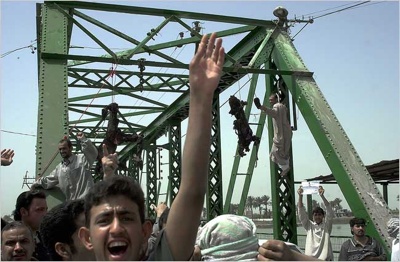
I certainly think the AP photo of the charred bodies of American contracters hanging from the bridge in Fallujah will be remembered. They are such a pointed contrast to the staged demolishing of the statue of Saddam that occured upon the US forces entry into Baghdad in April 2003. That was supposed to be the end of the war, and yet we know better now.

Wednesday, November 15, 2006

moving beyond the media aspects of my project into the influence that art plays. i am beginning with the iconic images that have come out of war and embedded themselves in the public consciousness. Also looking at how art has played a role in unpacking the public consciousness of war, largely viewed through the lens of media coverage. Vietnam is the first war that comes to mind when I think of controversy, public scrutiny and a barrage of communication from media, to public protest, to artistic expression. I think this war is commonly held as being at the forefront of these types of social commentary, however, as I have found, this dialogue between media, the public and artists has existed in every military conflict.

a few images that I have been looking at:


John Trumball, The Death of General Warren at the Battle of Bunker's Hill, 1786

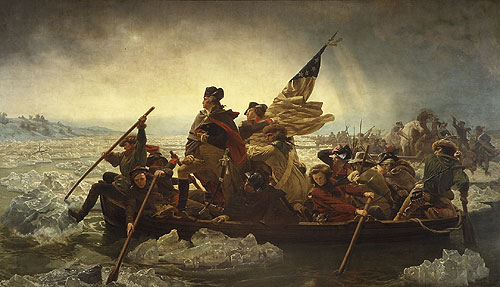
Washington Crossing the Delaware, 1851 Emanuel Gottlieb Leutze


The romaniticized view of war, the images that these ordeals inspire even decades after the event by those who may not have been alive during at the time.

A new wrinkle that photography brings, a gritty reality, unlike anything that had been seen before. Is it art or journalism?


Timothy O'Sullivan, Dead Soldiers on Battlefield-Gettysburg, PA, 1863


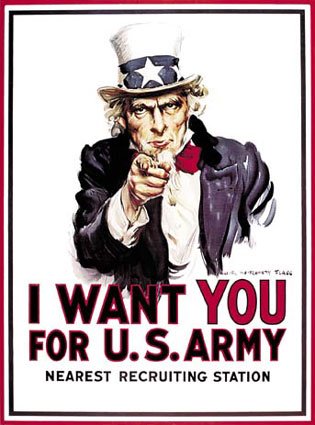
Posters and propaganda. Reproducable artwork. Images that endure and become reappropriated.


James Montgomery Flagg, I Want You for the U.S. Army, 1917


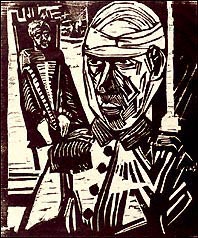
Eric Heckel, Zwei Verwundete (Two Wounded Soldiers), 1915


The foreign influence, and the beginning of new movements, Dadaism, that came out of war.

Joe Rosenthal, Raising the Flag on Iwo Jima, 1945


The lasting icons of American history. Reproduced endlessly, commented on again and again. The amalgamation of journalism and art. The way that one image can encapsulate the tenor of an event and reflect the larger consequences inherent to war. These images transcend the war itself and endure well beyond the scope of documenting military maneuvers. They are human history, human cruelty, suffering, triumph, terror. They evoke a sense of why we focus our attention on these conflicts, what we miss in the news, and are sometimes direct commentaries on the media.


J. Howard Miller, We Can Do It!, 1942-43

Thursday, November 02, 2006

In my last post, I was beginning to peruse the notion of an artist's role in questioning the actions of a government. I think that is how I initially fell into this topic of research. I say fell because I really don't think I chose it as much as I felt it is an area that interested me and I needed to pursue it futher. Working in the media, I have become more critical of the tactics and the outcomes used in this business both on a local level and on a global scale. It is so critical to the public to get the correct information and to have it delivered in a way that is coherent and unbiased as possible. I have often considered how I found myself in this career having studied art in college. It has taught me a great deal, mostly about working methods in storytelling and using video as a medium to this end, but also about ethics and the nature of objectivity. In news, as in documentary and any art that we make, there is also some subjective opinion, some decision being made, it affects the outcome of the piece.

The focus of this class relates more closely to art and politics than it does to media studies, but I felt that these areas are so closely intertwined with what interests me right now in my studies. I think that I have come to the point where I enjoy making art that may hang on the wall of a gallery or in someone's house, but I recognize the limitations of that endeavor. That is not to say that is all it can be. For the most part however, this type of art can only reach a very small audience, and how much of that audience considers it closely enough to get something from it? Television, as well as film, whether it is news, entertainment or otherwise, reaches a very wide audience, but rarely is incredibly thought provoking. When it is, there is nothing more powerful to me.

This is where my interest as an artist lies in dissecting what the role of television, film and the media. It affects the decisions we make on a daily basis more fully than any painting or photograph can, no matter how much we want that not to be the truth. There is an incredible responsibility that exists in that power. Within the scope of my research, there are elements of politics, military conflict, reporting of information and the propaganda and censorship that comes out of that. These are also issues present in art and they are the things that influence art. We are in a better position to question them than the reporters that cover the story, or the politicians who spin it or the viewers who simply accept it as truth.

I have been looking a lot at the websites of different film makers and media artists. Here are a few to check out:

http://www.errolmorris.com/ the "official", yes "official" Errol Morris website. if you are interested in documentary, or just damn good film, check it out. also a lot interesting commercial work and various other media

http://www.mayslesfilms.com/index.htm if you haven't seen any Maysle's films, then you are missing the verite in your life! this is a good primer for where to start, lots of good info if you are already a fan.

http://www.alanberliner.com a documentary film maker and media artist who works extensively with archival film footage and employs interesting editing techniques as well as using various media as part of installation works in gallery spaces

http://phfilms.com/ the home of Pennebaker Hegedus Films, as in D.A. and Chris. more quintessential verite, think Don't Look Back and The War Room.

http://www.vdb.org/ the video databank-a collection of work from media artists, a listing of various artists found in that collection.

http://www.hi-beam.net/cgi-bin/flicker.pl flicker-a listing of film and video artists, venues for work and links to related material

this is hardly scratching the surface of what's on the web, and of course there is much more beyond the scope of what exists online.

Monday, October 30, 2006

Been away a while...

need to catch up, but it may take a few days.

I needed a break, so all is well. Things are moving along in my research. It has evolved to take on the perspective of government propaganda as well as censorship as they relate to media's relationship to public perception of war. The current situation in Iraq is such a great example of this. There has been such a concerted effort to control and spin every piece of information from Abu Graib to the absence of WMDs. The media has still failed in many ways to overcome some of the obstacles to truth, but at the very least, the negligence of our current policies seem to have forced to light some of the important issues and brought some accountability to the powers that be. That is not to say we are getting the whole truth or there is enough accountability, but the talk of a change in tactics is a welcome sign.

For the most part, the war coverage seems to have become a daily update for the egregious violence that is occurring all the time. There is little new information raised. It is almost glossed over to the point that one has to wonder if there is even anyone left over there covering the war. More wallpaper video, more bad news of casualties and deaths. No new stories coming back, no pressing for answers. We seem to accept the status quo, although the general public is less accepting everyday.

Sooner or later the current administration is going to have to make some effort to appease the audience, or more likely, they will stretch it out to the point of leaving it for the next guy to clean up after. The growing trend with government media relations has been to work harder to control the flow of information as technology changes in the field and journalists become more and more mobile. This tactic, usually reserved for war has crept into the daily mine field that is our current political landscape. As artists, it becomes necessary to question this system, since the media often fails to do so. We are not under the same constraints, yet we are dependent upon the movement of information in a truthful way in order to comment on society as a whole.

Monday, October 02, 2006

I loved this story, apropos to the discussions of last week on mapping. I read it just a day before class.

http://www.nytimes.com/2006/09/28/nyregion/28map.html?_r=1&oref=login

This idea of psychogeography is an interesting notion. I think that often the function of a public space is not fully considered in respect to how it inhibits human behavior. It is almost accepted that some inhibition is a good thing. Is it useful to discuss these far fetched approaches to city planning? They are interesting concepts, however they clearly can never be a reality. In the case of Walt Disney, much of his ideology has become a reality in a controlled setting, with the same basic rules of decorum applied to acceptable conduct within these spaces. Despite the effort to appear otherwordly, Disney World is still a place that requires the same general societal rules that apply anywhere else. It has in fact become a symbol of the corporate entity that controls our free thought and expression more today than ever before. A great deal of money is spent to draw our attention to this product, that movie or tv show and to return our own money to that cause of continuing to build a larger and larger capitalist empire.

There is no question that to a certain extent the Situationist views of psychogeography were never meant to become a reality, but more to influence our thoughts about how we design public spaces. In this respect it is a useful contribution as it does provoke some thought and it seems this is the fundamental function of art.

I am interested in the ethnocentric views of mapping that occur, particularly within this country. Americans are largely unaware of the world around them, unaffected by anything outside of their own realm. This comes down not just to ignorance of geography, but of culture as well. The map of the upside down world is one of the more interesting illustrations of this:

http://flourish.org/upsidedownmap/

Clearly, our most basic assumptions about the orientation of things is quite an arbitrary convention that has no basis in scientific fact but is more politically motivated than anything else.

Of course maps are about more than just geography. They have a vastly diverse matrix for the understanding of art, culture and the exploration of ideas.