Tuesday, March 30, 2010

A Bittersweet Homecoming

It's never easy to say goodbye. Whether it's a person or something that holds sentimental value, no one likes letting go. So when my parents told me a couple years ago they were thinking about selling the house I grew up in, it felt a bit like a punch in the gut at first. When it was built back in 1973, it was the perfect place to raise a young and still growing family. I wouldn't come along for another 6 years, and for the first 18 years of my life, and a brief stint after college, it was the only home I knew.

I think the realization that they needed to downsize into something more manageable came around the time my dad was diagnosed with Alzheimer's. It was a blow to all of us, but at the same time, I think it brought our family together. My siblings and I knew it was time for us to give our parents a helping hand, just as they had so many times for us growing up. What had been a hard pill to swallow at first blush, turned quickly into a call for action. And so we set about trying to get the old place standing tall, quite methodically I might add, readying it for sale and contemplating just what the next step would be.

It wasn't until this spring that we'd be ready to think about putting it up for sale. After much handwringing, when my parent's finally met with a realtor, they marveled at what they saw as a gem in a very sluggish market. After nearly 4 decades in this place, they ended up listing it with the same agency that had originally sold them the house, and in some ways it brought some comfort that we were coming full circle.

When they made the listing official and I looked at the description and the photos, and ultimately the asking price, it was more than a bit surreal. It all looked good, and I felt anyone who were to see it would certainly want to give the place a look. At the same time it felt odd to quantify the value and parameters of this place that held so many memories for me, and for all of us. It was more than a 4 bedroom colonial. It was the place where I learned to dribble a basketball, played hide and seek with the neighborhood kids and where I returned each night to crowd around our kitchen table with my parents and 6 other siblings for dinner. It was home. Our home. And to think of putting a price on that and allowing some stranger to bid on something that was a part of our history, why it was unthinkable. But then the rational adult mind takes over and with a smile, I said to myself, "someone is really going to love this place just as much as we did".

Just a week or so later that person came along and I believe she saw in it just what we had come to know over the last 30 plus years. Less than two weeks after it went on the market, it was sold, and much to our relief at a fair price.

My parents had been thinking about what would be next for them, as we all had for quite some time. In the end, they decided to build a much smaller and more modest home, just around the corner from their current residence in a rather new development, that for my entire childhood had been just a barren field. Just as when they moved into 105 Pamela Lane, they will be only the second house on a new street, aptly named Brentwood Lane, the same name their current street once had before it was renamed.


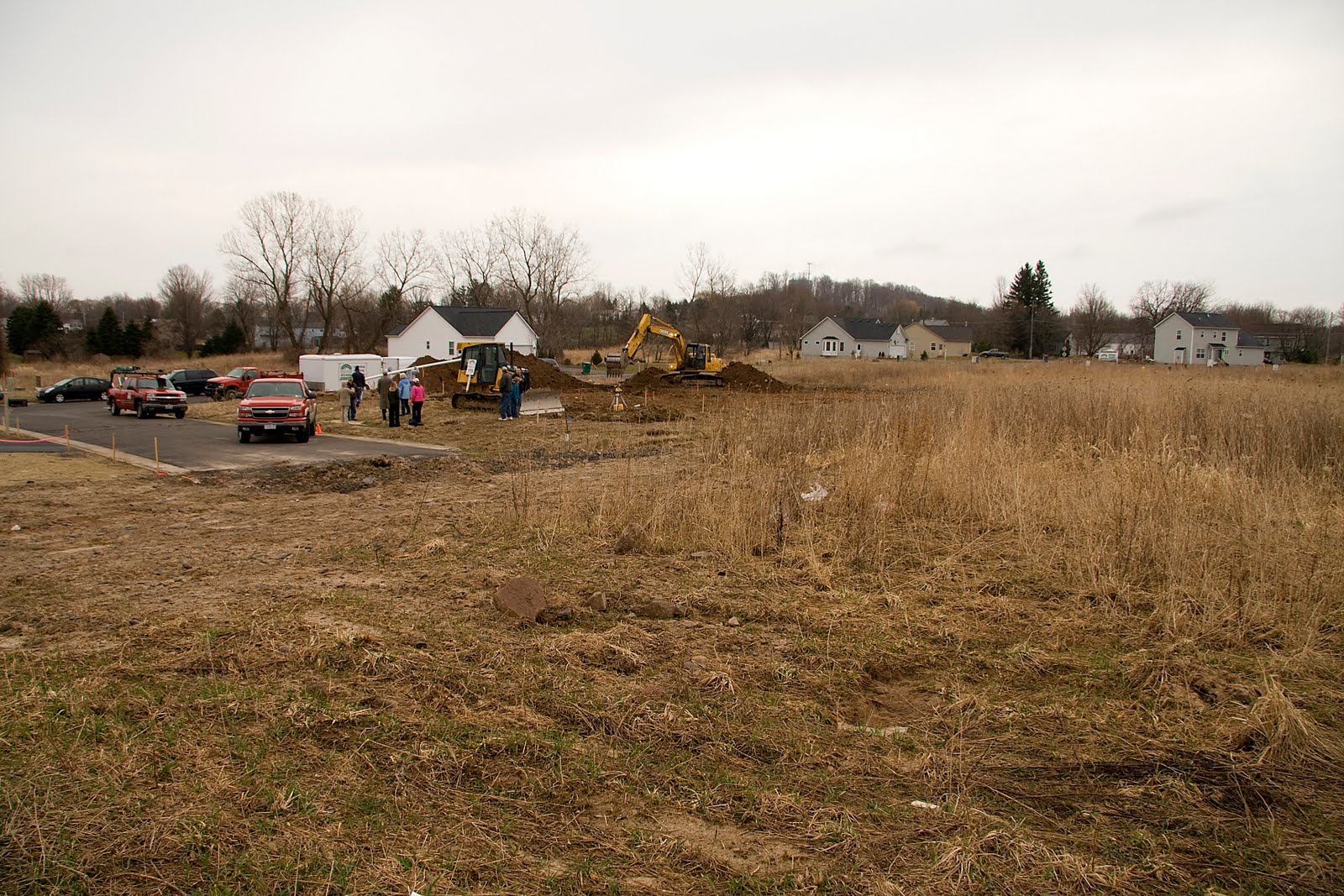
On a drizzly, grey morning last week, I met my parents, along with two of my sisters and some of their kids at the site of the new abode. With the old house sold it was time to break ground on the new one. They make quite a big deal of these things, making a party out of the event, which includes the usual breakfast fare of bagels, donuts, coffee, and of course, what celebration would be complete without a bit of champagne?


The backhoe made quick work of the basement as we walked about muddy layout that was only an outline in bright orange spray paint on the dirt. We surveyed the area, and I reflected on how much has changed since we had ridden on bikes through there some 20 years before.


As the crew broke for a minute, the foreman of the team beckoned to my parents and suggested a photo op with the heavy equipment to commemorate the moment. As my mom gingerly climbed onto the the large steel treads and into the cab of the backhoe, my dad struck a pose just beside her. As always, I was ready with my camera to snap a few shots.


As hard as it had been to think of saying goodbye to the place I'd called home for so many years, any sadness was immediately wiped away by the smiles on my dear parent's faces. I know for them, this was a relief. They didn't relish the thought of relinquishing those precious ties to the past any more than I did. But I suppose as we all grow older, and things become less and less certain, it's a good feeling to make a decision and see the progress that it produces. In this world, there is nothing that will last forever, whether it's made of flesh and blood, or rafters and beams. We must savor each precious moment in the present, and try never to look back with regret. As for my parents, I'm happy to have helped to make this process just a bit easier and I look forward to future family gatherings in their new home. To be honest, it's a bit of a relief for me too, just to know that as they grow older, they have one less worry, and a great many blessings to be thankful for.
Saturday, February 20, 2010

Striking A Balance

It's difficult these days to disconnect oneself from the myriad of distractions that keep us from focusing on our own well being, and on the things that really matter in life. It used to be that if people needed to reach you, they could call your home, or gasp, they might actually just send correspondence through the mail. Ever watch an old movie and think, if they just had a cell phone, they could warn the protagonist of impending doom?


But that was in the stone ages. Nowadays, I can be reached at my home phone, cell phone, work phone, any number of my multiplying email accounts, facebook, twitter...you get the picture. And there are people who have even more distractions in life than I do. It gets to the point where these modern conveniences that are supposed to make life easier, just end up making it more complicated. In some cases, they are a downright nuissance. ("I have how many emails in my inbox?")

So to truly get away from it all is a challenge, to say the least. Ever since I completed the arduous task of putting together a thesis for my Masters program, I'm still getting used to having my life back after a 3 year hiatus from normalcy. I have to try to remember what exactly normal feels like again. And I'm finding that, like the Thomas Wolfe novel, I can't go home again. The simplicity that once existed in my life, before graduate school and a career, marriage and a mortgage, and all of the things that seem to come with adult life, that is something I will never get back.

The best I can hope for is a week of vacation here and there, maybe juanting off to my tropical paradise in Puerto Rico, or the long overdue visit to my high school friend in Hawaii. And each time I find myself in these idyllic surroundings, I think, why don't I just stay? Do I really need to go back to that other life in that cold, grey place, where actual responsibilities await me? And yet as tempting as it is to never return, return I do. But you know what? As nice as it is to get away, I'm sure someday down the road, I'd find myself swinging in a hammock beneath the palm trees and think, I'm bored. Wonder what the folks back home are up to? Call me crazy, but work is in my blood and I think in some ways it keeps me sane, or at the very least, grounded.

We all have a calling in life and I guess for me, that calling is to be here, at least for now. And while life will inevitably continue to be anything but simple, I know that I have to keep moving forward. I still have much more work to do, as much as I'd like to kick back and take it easy. I'm afraid that once a place is no longer just a temporary escape from our everyday life, it can cease to be paradise. To have a place that I can call home, where I am surrounded by family, friends and all the things that are dear to me in life, this is what puts things in perspective and makes me realize just how blessed I am.

Tuesday, January 19, 2010

The Importance of Family

It's funny how so often we fail to appreciate something until it's gone. For the last few weeks, my wife Norma's family has been holding a vigil by her grandmother's bedside as she fades in and out of consciousness. At 91 years old, Mami Andrea, as she's affectionately called, has lived a full life, but the day we have all dreaded may be coming soon, when we finally have to say goodbye to her. And so we wait, and we watch over her. We hold her frail hand, we kiss her furrowed brow, caress her long silver hair and care for her as she cared for so many of those who now surround her.

I was fairly young when each of my grandmothers passed away, and I never really had an opportunity to know my grandfathers, so it has been an unusual experience for me. I've never watched someone as they lay dying. It's heart wrenching to see them so helpless, and to watch those left behind who are trying to come to terms with this loss. I hate to see anyone in pain.

It has made me think of my own family. In particular, it has forced me to look at my parents, and face this reality that they will not always be here. Two years ago, my dad was diagnosed with Alzheimer's, and to say it was a bit of a shock to the system is an understatement. It's not that we didn't know already that something was going on. The symptoms were clear long before the diagnoses. But to give a name to that suspicion was quite devastating. It made that inevitability of death feel that much more real.

In the time that has passed since, each of us have learned to accept these facts, and tried our best to support both my mother and father. In some ways, it is harder for those who live with this person that has been given such a diagnosis, than for the person themselves. I think Dad has accepted it finally, and begun to learn to live with it. His spirits seem high when I see him, though I know this is not always the case.

Having grown up the youngest of seven kids, I was always used to being surrounded by my family growing up, for better or worse. There were certainly times when I wanted them all to leave me alone. But now that we have all grown up and moved on to have families of our own, it's harder and harder to find that togetherness we once had. It's difficult to think about, but I sometimes have considered, how many more times will I have to spend with my mother and father, brothers or sisters before they're gone? When I consider that I see some of them only once a month, a few times a year, or less, it makes me want to drop what I'm doing and organize a family reunion. But realistically, we have to live our lives, wherever that may take us.

I had an opportunity to give my parents their first digital camera this Christmas, with the hope that they might take more photos to preserve the memories that these days are becoming increasingly precious. Whenever I look back at all the old photos, I think of how this record of our past still seems so real to me, like few things in life. It pains me to think of things that have gotten in the way of being together as a family. Distance, career, kids, the responsibilities of daily life and sometimes these little rifts that pop up in every family.

When you look at the frailty of life, and consider how it can be taken from us in a split second, at any time, any place, it forces us to take stock and reconsider our priorities. Now that the holiday season has come and gone, I hope that each of you had an opportunity to get away from the distractions of daily life, even for a few hours, to be with those family and friends that are dear to you. As our lives become busier and there are more of those distractions, hopefully it won't take a holiday or an illness to remind us throughout the year just how precious these people in our lives truly are.

Friday, December 25, 2009

Working Through the Holidays

I've been trying to get in the Christmas spirit this year. I really have. I've done many of the usual things one does: decorating the tree and the house with lights, shopping for gifts for family and friends, baking and of course eating the festive treats and listening to Vince Guaraldi doing "A Charlie Brown Christmas", among other holiday tunes, as much as possible. But I can't shake it. It doesn't feel like Christmas. It feels like any other day. I suppose it has something to do with the fact that I am spending yet another year working through Christmas, and not just any shift, but the dreaded overnight shift. It's the nature of working at a 24 hour news station. The news never, ever stops, and so neither must we. So as Santa is flying over Rochester, I'm listening to the scanner to make certain that some crackhead doesn't shoot down his sleigh and make off with your gifts.

It was actually a fairly quiet night this year, which is not always the case. My shift started early with a woman running her car into a house out in Perinton. I'm told no one was home at the time, because that would've certainly messed with your head on a night when sugarplums should be the focus of mental activity. Finishing up there, I scrambled off to Sacred Heart Cathedral to catch the tail end of midnight mass. Normally, I kind of dread this, only because it's expected that I'm going to get some sort of soundbite, and of course it's the same thing every year. No one has the time or the desire to talk to me about the meaning of Christmas, and what is there to say that hasn't been said a thousand times? But this year, for some reason I was looking forward to it. Maybe it was this inkling in the back of my mind that it could potentially be my last year doing this. I actually missed it last year, being stuck at a standoff half the night (that's news speak for a guy in a house with a gun, and they usually go on a while). I thought that might be the case again this year, but I squealed into my illegal parking spot right in front of the church just before 1AM.

Fortunately, they were running late, so I had plenty of time to get video, and since there would be no opportunity for an interview, I was off the hook with that. A little nat sound of the choir, some shots of the manger scene and people praying, and I'm golden. So I stuck around, not having darkened the door of a church all year, and silently recited to myself the ritual responses to the bishop's prompts. It felt good to be there, like it was the first bit of Christmas I had felt all season, albeit for just a few short minutes. I'm not by any means a staunch Catholic, but I grew up in the church, and though I haven't been a regular mass goer in a while, there is something about midnight mass that is appealing to me.

I live right around the corner, so I took a drive by the house to make sure all was quiet there, as I sometimes do in the wee hours when I'm working. Then I took a leisurely route back to the station, accompanied by Vince and his rendition of "O' Tannenbaum". It's almost eerie how everything shuts down on Christmas. Even Lyell Ave. seems to genuflect just a tad. No parka clad ladies of the night were visible strolling down the sidewalks, no dealers on the corners, and even Louie's Cordial had dimmed the lights for one night.

I guess it's hard to get in the Christmas spirit when you haven't had one off in going on a decade now. No pity party for me though. I know I'm certainly not the only one. Some have done it far longer than I. But does that make me feel any less ambivalent? Not in the least.

I have such fond memories of Yuletides past. The traditions of decorating and baking or the anticipation of what treasures awaited me under the tree. Running downstairs at the crack of dawn to tear into presents with a fury reserved for childhood zeal. And most importantly, spending time with family, which these days is scattered about the map. Now I spend my Christmas morn with cops and firefighters.

The magic is gone. And I guess that is part of growing older. The reality of life gets in the way of dreams and wonder. But I still long to have those traditions back and to share them with my wife and someday my own kids. But instead, I must muddle through, as so many others are, my wife included, by working this Christmas. And I can only hope that perhaps in 2010, I can look forward to having a chance to celebrate Christmas at home, with family, the way things used to be, and raise a glass of eggnog to some other poor slob whose only wish is to be at home with his family.

So on this Christmas, wherever you are, whatever burdens you may carry, much greater than mine no doubt, may you and your family find some of that joy of the holiday season and spread it to others who need a bit of cheer.

Monday, December 21, 2009

In Search of Roots

Do you ever get the feeling that when you're searching for something, sometimes you have to go the long way around to reach your destination? I just finished this documentary about keeping culture alive across the generations. I looked at the family I married into and how they have managed to keep their traditions alive, despite being separated from the place where their roots lie, which are mainly in Puerto Rico. It's called Arroz Con Habichuelas, and some of you may have seen it. It's a metaphor about culture and how we take all these traditions and blend them together, and somehow each part can still be distinct while enhancing the experience of the whole. This stood in stark contrast to my own family. Though we had our traditions, they weren't strongly connected to any particular cultural history. And as the American story goes, I think that mine was probably the more common one.

I heard from so many who told me that they related to the narrative in one way or another, but mainly the loss and the longing, that hope that we all have to reunite with our past. I think that it almost takes going through that experience of looking at a family that is not your own, to gain perspective on the one that you were born into. And so I have found in the last month that I suddenly have this itch for the first time in my life to really know something about my past and where my people came from.

The extent of my knowledge about my family's ancestral roots stems mainly from a school project I did in third grade, which consisted of finding clippings from old magazines that somehow symbolized our ethnic ties and pasting them on poster board. I still remember asking my parents where we came from, having utterly no clue, and getting this vague explanation about being a little Scottish, a tad Irish, with a bit of German and Polish thrown into the mix. At that age, I was satisfied with this answer, but I suppose there is a reason why that one small assignment has stuck with me all these years. It wasn't until I grew older that I realized how appalling it is that we knew next to nothing about the generations that have come before us.

As time has passed, I have bumped into those roots from time to time. When my brother John went into the Marine Corps after high school and ended up in Scotland, I was quite mesmerized by the memorabilia that he returned with, but not on the level of a personal connection. The crest with our family name emblazoned on it, and the attached history of warring clans seemed exciting to an 8 year old, but it never went much beyond that. I recall discovering pierogies in the frozen foods section at the grocery store, but I didn't begin to connect that with my grandmother or any tradition that I knew of. I may be the only person on Earth that doesn't treat St. Patrick's Day as a personal excuse to engage in debauchery (though I've been known to raise a pint of Guinness or two), like so many of the non-Irish folks, all clad in green, that litter the streets mid-March of each year. And then there's the German Air Force jacket that I picked up at a surplus store in Boston years ago that I still wear from time to time, and my affinity for wheat beers and schnitzel, not to mention a fascination with long, conglomerated German terms, like gersamtkunstwert (a complete work of art).

These ties are quite tenuous to say the least, but my recent accomplishment of completing my thesis has left me with a fervor to learn more. And so I set out on this journey, which so many of my generation that I have spoken with seem ensconced in at this moment. It is a task of piecing together a history that in many cases was unraveled without much thought. I think this was for the most part unintentional on the part of my progenitors. I think that if I had the opportunity to ask my ancestors about their story, where they came from and how they got here, their response likely would be, "who me?" So often people have resisted talking about these things because they have felt, "my story isn't important. I'm nobody". But as one of my advisers pointed out during the process of making my thesis, it is often the person that persists in saying that their story is not important, that in fact has the most interesting stories to tell.

It's hard to say where this process will take me, and whether or not there is another documentary in it, but there is a sense of wonder about the prospect or digging up this past that you never even knew was there. Like my friend and colleague Chad Roberts commented at one of my screenings, referencing his own quest to find out more about his ancestry, "we're chasing ghosts". I knew that there would be those questions when I made this film about why I didn't look at my own family. I guess the only answer is, sometimes it's harder to look at yourself so directly until you have some of that perspective. And so with that in hand, its time for me to start listening to the ghosts from my own past.

Friday, December 18, 2009

The Constraints of Time

Without the obligations of an academic program to which I must daily and weekly pay my dues (in the form of creative output), I am able to move on to other endeavors. So I have found myself spending equal parts of time pursuing new avenues in terms of a career path, catching up on long overdue projects placed on hold, from updating my home's electrical capacity to scanning and restoring old family photos as part of a new genealogy project my brother John and I are embarking on, to just enjoying the freedom of being able to sit and watch a good film, or old episodes of The Wire. Of course, with one box checked off life's to do list, that doesn't bring about total freedom. On the contrary. It just opens my eyes to the myriad of other obligations and nagging chores that I haven't gotten to yet.

It got me thinking about the constraints we place on ourselves to get things done. I must ask myself this question from time to time: has life become too complicated? For all of the modern "conveniences" that we have now at our fingertips, I sometimes long for the days when I really could relax and not have in the back of my mind the flurry of activity, knowing what awaits me on the other side of this idle time. As Thomas Wolfe so aptly put it, you can't go home again, and this phrase rings true in the decades that have passed since he first committed the notion to print, more now than ever.

How many times a day will I lament the fact that there are not enough hours in any given day to get done all of the things that I would like? Of course, time is a flexible commodity, and we spend it as we see fit. Our measurements and calculations of it are arbitrary in the grand scheme of things. At times when I find myself tearing my hair out for lack of time to complete my obligations, I try to weigh those things in the scope of the bigger picture. Which of these things that gives me such worry at this moment will be on my mind one year from now, or five years from now, or 10 or 20? Which will hold even a minute place of importance? It helps to have the perspective that often the things that we fret about most are very temporary.

And with that thought, it is time to get about my day, and begin checking off some items from that endless to do list.

Monday, December 07, 2009

Social Media Explosion

Having been unfettered from the obligations associated with an MFA program, I've been trying to get my mind around this newfound freedom that I suddenly have. Of course, I still have plenty of obligations to keep me occupied. But now that a large chunk of that has been rectified, a proverbial monkey has been plucked neatly from my back, and I can pursue some of the cultural developments that have passed me by over the last 3 years or so.

One such experience is the plethora social networking tools available online these days. I have purposely avoided them up to this point, mainly because I didn't want to delve into them and not have the time to maintain this online alter ego, leaving a void of virtual detritus trailing in my wake. I hate the idea of some identity that is attached to me floating around in the vast expanse of cyberspace unchecked. And Lord knows I didn't need a single other distraction in my life.

So, upon completing my thesis just before thanksgiving, I set about catching up to where I left the world circa 2006. The first stop was LinkedIn, which was a simple enough choice, since it is a way to connect with other professionals, can lead directly down a new career path, and because I was invited by someone to join. So I logged in and began the process of building my professional narrative piece by piece. It was painless enough and so I trudged on.

Next stop was Facebook, which at different points, I told myself I would never have anything to do with. I softened a bit as I saw more friends catching up online, but held off until I could take the time to see just what I was getting into. I must admit, there is some trepidation in allowing any kind of personal info or thoughts to go out into this online labyrinth, chocked full of predators just waiting for any opening to seize on some vulnerability and do permanent damage to one's reputation and well-being. I've been the victim of identity theft on more than one occasion, fotunately with few lasting consequences, but nonetheless, I set my mind about treading quite lightly.

Once on Facebook, the floodgates seemed to open, compelling me delve into other areas, like Twitter, Flickr, Del.icio.us, and NY Times People to name a few. I suddenly found myself transfixed. So this is what I was missing all this time? I told myself that this was just a way to connect with family and friends who were out of town, since I'm so bad about calling and emailing. But I strangely found myself connecting, as much if not more, with people who live right in this area. It became quite effortless to interract with people that I might not otherwise see on a regular, or even semi-regular basis.

And now with that gap having been bridged, I find myself all in, testing the various methods of collecting and organizing thoughts, events, people, and this world of information that I encounter in my everyday life, as well as finding ways to share it. I never would have guessed it, but it seems to suit me. My mind is almost constantly buzzing with activity, bouncing from one thought to the next, and like the internet, referencing and cross-referencing, linking from one idea to the another, filling my life with endless information. I think this is why I am driven to make art, so that I have an outlet to encapsulate my meandering mental activity, harness it and quiet the cycle long enough to rest.

I used to scoff at the notion of social networking through these online tools, dismissing them as another distraction, an interface that serves to divide us and largely replace direct face to face interaction. While it certainly has these sort of pitfalls if we use it in that way, it has a much greater capacity to facilitate a more active dialogue, not just through the rather passive act of scanning and clicking on links, but through allowing us to reach people we might not otherwise run into and perhaps forge new bonds, while reconnecting with friends from years past. I see it as a sort of experiment, as we all evolve in our social or work lives, surrounded by technology and all that comes with it. How do we make sense of this sprawling landscape that is constantly unfolding and evolving? I can't answer that, but it's been good to get my life back and begin this process of catching up with what I've been missing.

Wednesday, April 15, 2009


The spring has brought a bit more sun, a bit more warmth, and most significantly for me, a bit more time to resume work on my thesis. With my teaching duties winding down in my first semester at Nazareth, I have begun to get back to the work that has been at the center of my creative energies for over a year now. 

It's hard to believe that it was last spring that I began this journey, taking me to new territory that has moved and captivated me. I often obsess over the details of shooting, at times working myself into a frenzy, worrying about all that could go wrong, as things often do. But as one artist once so aptly put it, the dog that never leaves the porch gets no bones. How true that is. So, I must press on, without fear of failure.

One of the joys beyond being in the thick of documenting some things that many people never witness, is the process of looking at what my camera has captured. When I'm out there, I'm in a different zone, acting on instincts, and at times adrenaline. I'm not always taking it in fully. The lens and the viewfinder, and all the electronics and optics that lie in between, act as a buffer to fully experiencing what I am witnessing. In this case of course, I am an active participant at times. My voice, and my perspective are very much a part of this project. So I am anything but a fly on the wall. But I truly revel in seeing the magical moments that are now suspended in time, moving forward and back at my control across the monitor. There is beauty in being able to preserve these details in the lives and history of a family that has become so dear to me.

As I begin this process of returning to that footage I shot just a few months ago, I am transported back there in a very real way. The feeling of that warm sun on my skin and salty ocean air are embedded in my sensory memory, leaving me longing for a swift return to that island paradise, away from these dreary Rochester doldrums we find ourselves in. But more than that, I find myself recalling the moments of recognition for my mother-in-law Lucy, her nephew Chegui, and for each of us in our own way, experiencing and sharing in something truly meaningful. It was not a vacation in the conventional sense. We were not seeking to get away from something as much as we were returning to something. For the older generation, a return to their roots and the places and people they remember from long ago. For the younger generation, a return to a different time and way of life so filled with an appreciation for family, and history, and the beauty of the natural world that is often lost in the pace of life in this country. And for me, a return to emotions that touched me to the core having been first welcomed into this family, and this culture nearly eight years ago.

As I seek to unfold this narrative of our trip and tabulate the words and pictures of that almost mystic place, these things rush over me. It's like a good book that you can't put down, and though I know the ending, I can't wait to get to the next chapter.

Thursday, January 08, 2009

I have officially decided to postpone my thesis screening to the fall semester. I have completed shooting after a very fruitful trip to Puerto Rico that yielded a great deal of captivating moments and stories that I think will add to the rich texture that is developing in the film. I feel that with the responsibilities I have taken on teaching this class over at Nazareth, I don't want to overcommit myself, nor do I want to rush in trying to complete what has been such an important piece of work for me. So I think it will be beneficial to take the summer to devote the proper time and attention to finishing everything. Hopefully, I will be ready to go early in the semester and everyone can make it to one of the screenings. I will certainly be posting more about that as I make progress.

Saturday, December 27, 2008


Call it a rude a awakening, but a week ago, I was standing up to my waist in crystal clear salt water, warm enough to bathe in, under 80 degree temps and sunny skies the likes of which we rarely see in Rochester, and then, it was as if I was so suddenly and so cruelly plucked from my idyllic dream and dumped waist deep (or nearly) into a frigid, dank, icy, tundra. It couldn't have been more ironic, stepping off the plane just after midnight, wearing a winter coat and a hat with "Culebra, Puerto Rico" emblazoned on it, and I was greeted by a slightly more bundled up airport employee on the jetway with the a sudden flash of recognition. "Culebra!" he uttered with gusto, referring to the tiny island off the eastern coast of the main island where I sunned myself and danced about in sparkling aquamarine water a day earlier. "I'm from there!" he said. I eyed his still dark complexion and bright smile, as I passed him, feeling too sleepy and depressed to give much of a response. I smiled back as I mustered a mental picture of this seemingly mythical place that only a few thousand people are fortunate enough to call home and could not help but think, and you left that to come here?


It's funny how getting away for a week to a place like Puerto Rico can leave even a land of milk and honey such as Rochester lacking luster upon returning. In all candor, I must say, though it is hard to come back, this place, despite its many flaws, has been the only home I've ever really known, and it is where my family, and my wife's family resides, which would make it hard to leave permanently. But one can't help but dream of a bit different life in a place so unlike anything we have here.


The trip, by all accounts, was an absolute godsend for all involved. I felt extremely privileged to be there, and to have a role in bringing my mother in law back home for the first time in more than two decades, not to mention, the fact that we made the trip as a family. And of course, to be able to document the whole thing, was magical for me. There were so many moments that moved me and just left me with an  enormous smile plastered across my face at times, and other times, tears forming at the corners of my eyes. 


It could not have been more poignant when we arrived at the house where Lucy had grown up, and she took one look at it, turned away and said, "I think I'm going to cry", to which her nephew Jose, or as we all call him Tio (uncle) Chegui, embraced her and said simply, "Welcome home." It was a homecoming for him as well, coming from Boston to meet us in the place where he spent some of his formative years as well, growing up in that same house. It provided the opportunity for him to reunite with his own father, who he had not seen in a number of years. 


From the recognition of old haunts, to the surprise at changes that have occurred in intervening years, it was a journey filled with revelations and a renewed sense of connection to something they had long forgotten about. We parted ways with the island vowing to return soon, and not allow another decade or two to pass until the next trip back. 


Now comes the difficult work of sifting through all of that material to carve the rest of the story from its rich narrative texture. More to come soon.

Monday, December 08, 2008

After a month of tearing out hair, pacing around in front of my computer, and general anxiety, I finally managed to pull it together enough to finish a rough cut of the first part of my thesis project. Actually, to be clear, it was the editing process that caused the above symptoms. Spending most of your "free time" sitting in one place doing anything will cause that I suppose, but for some reason this process was more mentally taxing than most.

This week, we leave for Puerto Rico, to return to my mother in law's home town, Arroyo, which will be her first trip there since 1985. The house she grew up in still stands there, but much has changed around it. It's hard to know what to expect, but this should be the culmination of the project, and I would imagine it will bring back a lot of mixed emotions for her as well as the rest of the family. We'll be there for eight days, and if I get a chance to hook into the internet anywhere, I'll make a post, otherwise, I'll save it for when we return.

12 degrees out at last check, and typically blustery for this time of year, so I'd say a return to the tropics is just what the doctor ordered.

Monday, November 03, 2008

I have been working feverishly to wrap up logging tape and put together my edit script for the first half, give or take, to my thesis. I use such urgent language because I have been setting goals for myself to stay on task, and feel lately that procrastination has won out a bit. There are always other things to accomplish, but this task must of course be at the top of my list. 

I have completed a rough script, about 30 pages in length, which concerns me a bit, because I really want to manage the pacing of the film, and it is always difficult to "kill your darlings" once they have been given life. It always happens that the first cut is much longer than what I would like and I always manage to get it down to size. Since this project is much larger than anything I have worked on, it is difficult to access what I have until it is laid into a timeline. Normally, I don't even work from a formal editing script, but the volume of material necessitated it. At last count, I logged 160 pages from around 13 hours of footage. After a few weeks of intensive work, I am satisfied with where the project stands.

I have also been continuing work with archival materials from VSW's vault. I found a little gem called "What Do I Look Like to Others?", a training film, judging by the fashions, dating back to the late '60s or early '70s. I gravitated to it mainly for it's rather probing voiceover by Rod Serling. I have also been working with some elements from a film called "Exposition", which takes a somewhat experimental approach to documenting a World's Fair. Among other things, the central work that I am dealing with is a film called "Rape of the Earth", which I must give Dave Frassetto credit for pointing out, albeit at random. I have found this to be the best method for discovery in a collection of this sort. This film, as one might guess, deals with human influence on the natural landscape. One other notable item is some footage from Charles Lindbergh's first trans-Atlantic flight.

I am preparing to teach a brand new offering in the Art Department over at Nazareth (my alma mater), which I am working on developing a curriculum for. I am beginning to feel like there are too many irons in the fire, but as long progress is being made, it's hard to complain. The class is a video production class, but with a focus on how the medium can be used as a form of artistic expression. I know a lot of you have been involved in teaching in one capacity or another, so any input is welcome. 

Monday, October 20, 2008

I am nearly done with logging tape, just about ready to compile my edit script before this week is out hopefully. I want to give myself enough time to at least complete a rough cut of the first half of the film, which will take place in Rochester and act as a setup for the trip to Puerto Rico. 

I have delved into some of the earliest tape that I shot for this project recently, leaving the last material to log at the very end. I hadn't planned to do it that way, but in some ways, it is a nice little bookend to the process. I just went through the first tape that I shot, which oddly,  was done on Superbowl Sunday. My wife's parents had brought Grandma home from the nursing home, which can be a challenge since she is rather immobile and completely dependent on others to get anywhere. Try lifting 130 or so pounds of dead weight and you'll understand. These occasions always revolve around her since she in many ways is still the matriarch of the family. In Puerto Rican culture, and I imagine in many Hispanic cultures, the women tend to have a dominant role in many aspects of domestic life, and particularly the eldest women are revered. Donia Andrea, a title of respect for Grandma, is always the center of attention when she does visit, and so I took the opportunity to document this rare occasion since there are only so many of them left. On a night traditionally reserved for an American past-time, the traditions of my family's Puerto Rican roots permeate the event. Lucy serves up chicken wings and chips, but not without some arroz con habichuelas (rice and beans) to accompany them. Spanish music fills the air and during a half-time lull, the TV inevitably flips to Univision momentarily.  

Holidays are always a good opportunity to capture family together, preparing traditional foods, spontaneously breaking into dance, peppering the air with a mixture of English and Spanish, at times within the same sentence. This is how I spent last Easter, and the 4th of July. It is most interesting to see how these days, not typically associated with Spanish culture per se, become reasons to celebrate their traditions. It is not that they always set out with the intention of transforming everything inherently American into a Puerto Rican festival, but it seems that their every action is so infused with the culture, they cannot separate one from the other. 

As I reflect on the material that I have shot, I am both amazed at the amount of content I have to work with as well as disappointed by what I see as missed opportunities. It is of course, impossible to capture every aspect of a culture in one documentary of any length. There will always be those events that I failed to get for one reason or another, as well as those that I thought were going to be so crucial, which in the end don't make the cut. I always try to remember a sentiment uttered by another artist: "If you are in love with an idea, you are no judge of its value". For this reason, I try never to fall too deeply in love with any single aspect of my work, but rather treat each element with an equal dose of skepticism.

Tuesday, October 14, 2008

I have been busy logging tape over the last couple of weeks, just finishing going through some footage I shot in August. After hearing the stories from my wife and her sister about the car rides they took as kids to their parents' old neighborhoods in Rochester, I knew that I wanted to go back there and experience it along with them. It had been a number of years since their last trip to Weld and Woodward Street, Hudson Ave., North and Scio Streets. In their day, these neighborhoods were poor, at times violent, with drugs becoming a growing problem. But they were nothing compared to what they are today. Many of the houses and buildings they remembered have been torn down, or are abandoned and neglected. If anything, drugs and violence are a bigger problem now, with poverty having grown as well.

Yet they did not lament the fact of change, even negative ones. To them it is just that, a fact. Sprinkled throughout the struggling spread of homes and businesses are those places that have been kept up, and the people who have stayed. They stick out even more amongst the depressed state of things around them. We stopped the car at one point and step out into the street and are greeted in Spanish by a woman who had just stepped out of her front door. She is hidden behind a mesh of fence, but my mother in law Lucy recognizes her immediately. Both she and my father in law, John, knew her from their years living here, though it has been more than a decade since they have spoken. She lives in the house where Lucy had last lived with her mother and several sibling before she was married. The house is a bit rundown and surrounded by rustic emphemera stacked about the yard, but in better care than some in the area. They converse in Spanish through the six or seven foot tall steel gate. She passes a few herbs from her garden over the top for us to take to our own garden. Her friendly demeanor reminds me of the people in Puerto Rico, the older generation that Lucy has spoken of, who always welcomed everyone, no matter who you were.

They spot another familiar face across the street and strike up a conversation with her. Then we are all invited inside the gate's confines to view the additions and subtractions to the house over the years. They reminisce for a bit, then make their extended farewells, the "Puerto Rican goodbye" as my wife often describes it.

We travel to the spot where my wife's parents first met. Only one of their original houses at the location still stands. My wife and I both have come to these neighborhoods in our jobs covering news stories, usually bad news. Shootings, stabbings and fires are common here and much of the area is worse for wear. It doesn't seem to reflect the positive memories that John and Lucy often speak of. But to them, this is just a sign of how time changes things, sometimes for the better, and sometimes not. 

Our encounter with the two old friends does remind me that not all is lost here. I think of our impending trip to Puerto Rico and what we will uncover as Lucy revisits a past that she tucked away more than two decades ago. It is bittersweet at times to revive bygone days in this way I suppose, and often,  it leads us to avoid a past that might otherwise edify our present.

Wednesday, October 01, 2008

I just wanted to finish up on my discussion of process that I began in yesterday's post (see below).

As I shoot, I try to spend time periodically logging footage, which is a tedious and time consuming task. Its importance to my process is immeasurable however. It involves a lot of playing and stopping tape, transcribing sound word for word, as much as possible, and making notes of the images as well. This does two things for me; first, it offers me the opportunity to review footage to find elements that I may not have noticed while concentrating on shooting, and second, it provides a detailed record that I can reference later by timecode to quickly evaluate and locate elements that I want to use in the final piece.

Up to this point, I have logged over 100 pages from the interviews and other material I have captured on over 10 hours of tape. I typically shoot a ratio of somewhere between 12:1 and 20:1. That is, for every minute that ends up onscreen in the final edit, I have shot between 12 and 20 minutes of raw footage. I have been working a bit more loosely, experimenting with things that may not make it into this film at all, but that I could use in the future, so I may end up shooting over 20 hours for a 45 minute to 1 hour documentary. I have heard of filmmakers who shoot on the order of 40:1 or more, which seems insane, but in the end is all about what works for an individual. In all, this is a lot of logging, but as I go through, it is essential to the process.

Once all my footage is logged, I go through all of my logged material and highlight any material that I think might be useful in the process. Initially, I try not to be overly discerning because once I have done this, I normally ignore anything that is not highlighted. Next, I highlight, in a different color, all of the elements that I think are important, and likely would work well in the final piece. This is not to say they all will make it in, but I go through with a more critical eye, evaluating the raw material for its inherent value to the narrative. Finally I go through once more, this time usually with a red pen or marker, and underline all of the most salient points, the things that I think must absolutely be in the film. These are the points that are at the heart of the narrative that I will build everything else around.

From there I will begin to lay down the sound of the narrative, and as I move through this and the story begins to take shape, I will start to write and experiment with my own voice in the piece, supporting the story that each character is telling.

As I continue on with this process, I'll share some of the stories that have come out during shooting and I'll have more to say about the shape that the story is taking.

Tuesday, September 30, 2008

I have been going back through some of the footage shot for my thesis this past summer. I wanted to say a few words about my process before I get into the content. This project actually grew out of a short I did during the summer of '07 for a week-long workshop at VSW. I had been working in documentary for a while and was encouraged by the instructor, Wendy Smith to make a more personal film than I had been planning on. My work typically involved allowing the subjects to tell their own story in their own words, quite literally editing my own voice out of it. The film that I ended up making during that workshop was called Arroz Con Gandules, in which my mother in law makes a pot of rice (the title is Spanish for rice with pigeon peas), a common dish from her native Puerto Rico. During the course of this 7 or 8 minute short, my mother in law discusses not just the preparing of food, but the culture that this grew out of. People who who saw the short responded to the rich character of my mother in law, but to my surprise, they also responded strongly to my involvement. The rapport that I had with the people in the doc was directly related to my relationship with them, and it was a very different approach than I had taken before. 

It wasn't until I traveled to Puerto Rico with my wife back in January, and spent time taking photos around the island while visiting various locations, including Arroyo, the town where my wife's family came from and where her mother was born, that I knew I wanted to do something more with this. There were so many stories there that I wanted to tell, and since her mother had not been back in more than 20 years, I knew that this was a trip that I had to make again with her and document as part of my thesis. 

The initial planning involved an outline of elements that I knew I wanted to capture, from the issues that I wanted to cover and the principle characters that would be central to the story, to the visual elements that I knew would be important to telling that story. I spent the spring working from that outline, and interviewing my mother in law, Lucy, my father in law, John, my wife Norma and her sister Andrea together, as well as their uncle, Hector, who is the younger brother of Lucy. My interviews, tend to be more conversations than covering a list of questions. I keep notes nearby, but rarely look at them during the actual interview. There are no pre-formulated questions. I don't want anything to distract from the discussion that I am engaged in with the person I am interviewing. This is of course complicated by the fact that I am responsible for operating the camera, however this trade off is necessary considering that having a second person working with me would change the complexion of the response that I am getting from my interview subjects.

I also spent quite a bit of time this summer shooting events of daily life to capture some of the visual aspects to help tell the story. I follow the traditions of many of the Cinema Verite filmmakers like the Maysles, or Direct Cinema, as in the tradition of Frederick Wiseman, with a bit more of personal involvement in the process, as with the work of Ross McElwee. I am guided by the instincts that I have developed shooting news for the last seven years, reacting to the situations, looking for moments, finding the visual cues, close-ups and cutaways that will allow me to create an atmosphere in the final piece that fits with the environment in which I am shooting. I also look for these things that will allow for edit points, developing sequences and cutting together sound in a way that will move the narrative forward without disrupting the visual flow of the piece. 

I'll continue this post tomorrow with a few thoughts on my process of logging tape and developing an editing script that I use to build a timeline.

Saturday, September 27, 2008

Had the opportunity to get into the film vault once again and this time I vowed not to get caught up in the organizing, moving, labeling or otherwise managing any aspect of the films collected there. I just wanted to screen something and take in that glorious glow of projected film. It's amazing how much is taken for granted today, to be able to pop a DVD in and instantly view a film without so much as moving from the couch to change a reel, or adjust focus, or god forbid, splice a broken section. Not to mention the fact that we can do so with a 60 inch plasma screen (or for most of us, likely something much less extravagant) without the 50 foot throw necessary to blow up a projected image that large.

So I grabbed a stack of cans, and headed for the deserted media center. I threaded the first one through the projector, started that baby rolling and... wait a second, what the hell is that awful buzz coming from the left speaker? Spent a half hour checking connections, trying different cables, no luck. Oh well, at least if I pan all the way over to the right, that speaker will be fine, right? But what is this crackle? Alright, well, I can screen Thanatopsis with no sound. It's really about the images anyway, just to get me in the right frame of mind. Perhaps it's having trouble with the mag sound strip on that film. I'll try another. No dice. What the @#?&**! is going on here? So I grab headphones and plug into the projector with just enough cord to awkwardly sit beside the door to the projection booth and view from the back of the room. This tactic gets me through Frank Film. I discover that the sound knob on the projector was turned up too high. That gets rid of the crackle. 

I view a very amusing Saul Bass short called Why Man Creates. Then I go to re-screen Report. Kennedy has been shot, and I'm in the sequence in which the motorcade is going by with short sections being played back repeatedly, while the start of each repeated shot is advanced methodically a few frames forward each time when suddenly, a calamitous crash comes from behind me. I nearly jump out of my skin and bolt from my seat to the projection booth to find the take up reel flapping and the rest of the film severed from it now on the floor. I shut off the projector and dejectedly inspect the damage. A jagged tear right through Jackie. A repair will be necessary. A frame or two will be lost. I suppose that ironically, this is one film that a few frames could go and no one would actually notice. 

I attend to this and then with some trepidation trudge on with Gasoline: More Run for Your Money. I'm hopeful for some useful moments or at least a shot or two that might work in a compilation film, but mostly it's just bad acting and some useful facts on how to get better gas mileage. I take notes on that and move on. Now for the curiously titled, Tumbles, Mumbles and Bumbles. I should have known better. A poorly produced sports blooper reel, complete with a mind numbing music soundtrack and a goofy voiceover track. I stick with it through the third ski jump fall and nix that selection. The afternoon is nearly a bust when I head back to the vault for one last try. A shiny can with a small reel marked "Lindbergh". Turns out to be some silent footage from Charles Lindbergh's original trans-Atlantic flight, and subsequent Mexican voyage. This at least holds some interest for me and brings about some ideas. So the day was not a total loss. Despite all this, it truly is a joy to have the screening room to myself and have the opportunity to blindly sift through what might amount to something truly worth searching for. 

Thursday, September 25, 2008

After last night's showing of Persistence, I attended the workshop given by Daniel Eisenberg at the U of R this afternoon. I must say that I normally am less apt to sit through an afternoon of experimental film than most any other genre, though Eisenberg's work certainly defies that pure delineation. There is so much work out there that passes itself off as experimental, and not in a good way. After viewing the film last night however, and having had the opportunity to hear some explanation of the thinking behind the work from the artist himself, I was much more willing to further explore his work and hear more about his methods.

It was interesting to hear his perspective on source material, his utter reverence for the subject matter, above his own personal concerns. I have embarked on the process of my thesis in a very different way, moving from a method in which I attempted to remove myself from the work, quite literally, to a storyline in which I play a central role. I am still sorting this out, but having listened to Eisenberg's perspective, I think there is validity in both.

One of the more salient points in the discussion stemmed from Eisenberg's introduction of the oral history vs. the traditional historical documentation. His films hinge on this principle of using the oral history to find the story, giving, as he puts it, "a real place" to the mind's image. The use of archival material reflects this in a different way than it perhaps was intended to originally, whether taken from documentary, newsreel or military footage for instance, he provides new context, finding and preserving moments of humanity that might otherwise be lost. This is paramount to his own personal feelings of the subject matter at times, allowing his audience the freedom to draw their own conclusions, not hemmed in by an overarching agenda set forth by the maker.

At the same time, the voice of the maker is always present, which is evident in the way that the material is assembled, and certainly in the choice of the materials that are drawn from. Eisenberg spoke of using materials in such a way that the generational aspect is present, in the sense that when the material is reproduced, there is evidence of that reproduction. The archival footage is re-shot, re-cropped, optically printed repeatedly, changing the look and thereby leaving the makers imprint.

I'll leave this post with perhaps the most important point that was made during today's session. Mr. Eisenberg posed the question that is on the mind of most, if not all artists, and that is "by what authority do I have to speak?" And isn't it true that we all question at one point or another whether or not what we have to say is valid? As he also mentioned, it is a lucky few who could claim not to have pondered that query. But it is by making work that each of us have elected to answer that call, whether the work is highly regarded and lauded for its poignancy, or maligned as a failure, it is our purpose as artists to find a way to communicate whatever it is that drives us to create.
Last night I attended the screening of Persistance, the Daniel Eisenberg film, which he worked on during the '90's while living in Berlin, right around the end of the Cold War. It's a striking film on many levels, more than I could write about in one sitting, however, I wanted to record a few of my initial thoughts.

The film begins with three memorable images, each pulled from archival footage, as much of the film's imagery is. The first is the silhouette of an angel, which appears superimposed over a backdrop of the washed out sky and the blur of tree branches flying past, at times obscuring the view of our subject. The statuesque figure rises from the left side of the frame, shaken by the jitteriness of the handheld frame, apparently captured from the window of a moving car or a train perhaps, and yet it remains relatively fixed in its resolve, defiantly remaining unmoved from our view. It seems at first to be mounted to the moving vehicle, as if a hood ornament might appear, but its recurrence throughout the film later reveals it in a slightly wider shot to rise above the landscape on a pedestal, as a monument, for the purpose of the film to symbolize a salvation of some sort.

The second image is an aerial shot taken presumably from a military plane just after the end of WWII, showing the bombed out ruins of the German landscape. It is eery both from the perspective of the abject destructiveness that results from war, but also for the signs of life below, mainly in the trucks that continue along the roads that wind through the shell of a once vibrant place. Various shots similar to this one are shown throughout the film with people, both soldiers and civilians wandering amongst the wreckage, reminding the audience less of the acts of war that created the devastation we see, but more of the fact that life continues on despite it. Mr. Eisenberg shed light on one such moment that occurs later in the film in which two German women attempt to navigate the rubble of their town by wobbling their way across long, cylindrical, steel supports that once served as the structural elements of a bridge, but had been toppled to the rocky substrate that now covered the ground. As they climbed upon this unwieldy foundation, they swayed, as if novices attempting some sort of balance beam routine. Two passing Russian soldiers observed their struggle, and rather than passing by oblivious to the effort, one of them stopped to offer a hand, assisting one of the women on her journey. As Eisenberg pointed out, this rather foreign gesture of kindness between these people on opposite sides of political upheaval was captured by an American soldier, and in a way, these characters, each from a disparate social strata shared in this moment of humanity amongst the insanity that lay all about them.

The third shot, which is another of the recurring images, introduces a more familiar cinematic character, that of Edmund, the child protagonist of Roberto Rosellini's classic Italian Neo-Realist portrait of post-war Berlin, Germany Year Zero. For those who are not familiar with that film, his character appears as just another lost soul, wandering playfully amongst the wasteland that remains of his former city. For those who know the endearing and tragic story of this character, it takes on a new life, outside its original context, though it elicits a similar emotional connection as existed for audiences of the original film.

The mixture of new and found footage is used effectively in Persistence. The old 16mm, particularly the color footage, has that tactile quality to it, filled with a vibrancy that breathes through the frame with its distinctive earthen palette characteristic of the color stock of that era. It is visceral in its visual impact, reinforcing the bitter reminders of a society lost to the long, unrelenting Allied bombing campaigns. Even in the new footage, shot in the early 1990's, we still see remnants of conflict through building facades still crumbling, half demolished, or pock marked by the bullets that were strewn across their surface decades earlier.

One church in particular that Eisenberg focuses the lingering lens of his camera upon is one that has been nearly destroyed, but is finally being rebuilt. We discover that the church had been in disrepair even in its pre-war years and that the congregation, who had fervently supported the rise of Hitler, had hung a banner on its front that read "the Fuhrer will rebuild our church". After the church had been all but destroyed during the war and the Third Reich fell, the banner was replaced with a new one that read, "this is how the Fuhrer rebuilt our church".

We see these symbols of destruction and later, signs of rebuilding as Eisenberg comes to terms with his own oral histories of his Jewish heritage. Having been born in Israel, the descendent of victims of the Holocaust, he returned to the place of this horror, finding common ground with descendants of the perpetrators of these events and through it, finding reconciliation.

As we see the mammoth statue depicting Lenin being prepared for dismantling, while evidence of the churches, synagogues and the rest of the crippled infrastructure in East Berlin is being prepared for rebuilding following the end of the Cold War, we never actually see the actual work of addition or subtraction. We see only the laborious effort of assembling scaffolding, but never a block of masonry being laid or a sledgehammer striking stone, as with those iconic images of the Berlin Wall being toppled. The significance of this fact is up for interpretation, as is much of the film, and that is Eisenberg's intention. I suppose that for a city that for so many years lay in such a depressed state, the actual process of rebuilding is immaterial. That part is far less interesting, and far more predictable. Eisenberg points out that in more recent trips back to Berlin, the schism of East and West has been largely eradicated and that there is no longer any real visible evidence of the years of disarray. The buildings have been rebuilt, roads repaved, and life has moved on. This film does not seem to be about that process of laying new mortar and brick. To me, it is much more about the people, and the remarkable fact that even in the wake of such devastation, life somehow will persist.

Tuesday, September 23, 2008

I spent some time in the film vault at VSW yesterday, perusing the oddities of the collection. There is quite a bit of odd, which is mainly what I'm looking for right now. Having just entered my third year in the program, there has been precious little time to spend amongst the rather sizable collection of 16mm. To satisfy the practicum requirement for the program, last fall, several of us decided to organize and catalog the titles in the vault into a searchable database, which is nearly complete, and will be a useful resource for anyone looking to access materials. Having worked many hours on that project, I decided as I near the end of my time here, I needed to spend some time bringing some of that celluloid gold to the light of day. So I am working on compiling some found elements into a new film, taking pieces, and creating a new context for them. The technique is certainly not new. In fact, this week is a great opportunity to see and hear about the work of Daniel Eisenberg from the filmmaker himself. He is someone who has worked extensively in this mode, so I look forward to seeing his approach since I have not explored this method much in my own film work.

At this point, I am looking for the obscure; whether it is from science and educational films, or lesser known documentary and news footage, basically anything off the beaten path. I'm drawn to certain titles like "The Golden Age of the Automobile", or along similar lines "Gasoline: More Run for Your Money". Perhaps "The Skeleton: Our Fantastic Framework" will hold promise, or "Is Everybody Happy But Me?". How could I avoid at least viewing the ever enticing "Tumbles, Mumbles and Bumbles"?

I must begin by returning to a film that, at least in part brought me to this project: Bruce Conner's 1967 film "Report", which employs various footage of the JFK assassination in very interesting and unorthodox ways, along with running commentary from a radio report of the incident.


The film produces a fascinating reflection of our societal impulse to revel in, as we are simultaneously repelled by (or at least feign to be), the graphic violence of such an event. It also provides a fascinating commentary on the inane minutiae that at times envelopes the world of broadcast news, as I am all too aware, particularly now in the age of 24 hour news cycles, where reporters and anchors are left to blather on incessantly over layers of graphics and recycled video footage, whether it has relevance or not.

It reminds me of a very intriguing piece by German video artist Bjorn Melhus that I saw at the Denver Art Museum entitled "Deadly Storms".


You can view a short clip of the piece here: http://www.rockymountainnews.com/videos/detail/bjorn-melhus-video-installation-dam/

The piece was both a humorous and astute criticism of the frequent absurdity of the modern formula that television news broadcasts have adopted. It used a far different method than Conner did, and the different eras they were done in also separates the tone of the two works, however they share the critical viewpoint, lingering on the conceptual nature of the imagery, nearly to the point of monotony. And of course, each owes its material directly to very medium that it critiques. In the case of "Report", the use is even more direct than in the Melhus piece, however both attempt to mimic something, even mock it in a way. My approach, and my outcome, will likely be very different, though looking at these types of works is always useful in consideration of how to make use of archival materials.